
A Practical Strategy for 100% Completion
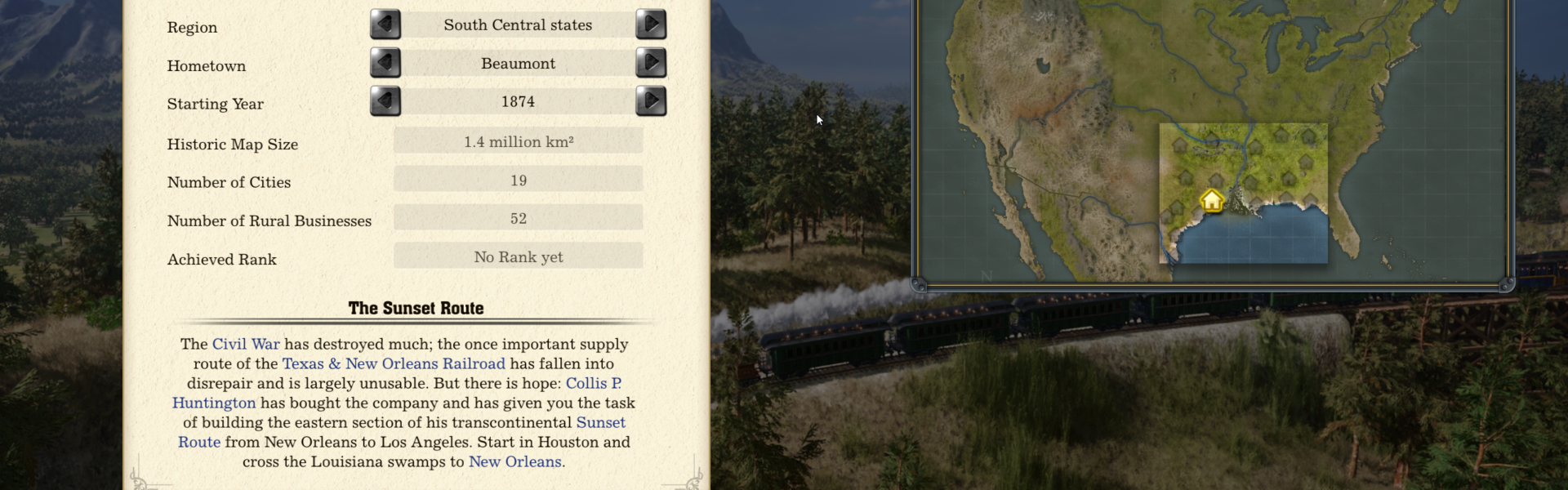
This guide rewrites and streamlines proven strategies for Chapter 4: The Sunset Route in Railway Empire 2 by Kalypso Media.
It is designed for players who want clarity, efficiency, and 100% completion without repeated restarts.
Understanding Chapter 4: The Sunset Route Objectives

Before laying track, it is critical to understand what makes Chapter 4: The Sunset Route challenging:
- Massive cash requirements (competitor buyouts are expensive)
- Late-game population goals (3 cities reaching 80k+ population)
- Heavy passenger, mail, and freight congestion
- Very low tolerance for inefficient layouts
This chapter rewards planning and punishes improvisation.
Phase 1: Opening Moves (Pause Immediately)
- Pause the game as soon as the chapter starts
- Connect rural stations
- Random connections are fine
- No trains required
- Private rail networks
- Buy only if blocking key routes
- Sell all assets immediately
- Initial city connections
- Beaumont → Austin → Houston
These cities form the economic backbone of the scenario.
Phase 2: Economic Strategy for Chapter 4: The Sunset Route
Avoid:
- Single-track routes
- Mixing freight and express trains
- Random expansion
Prioritize:
- Express passenger and mail trains
- Parallel track layouts
- Scalable station design
Phase 3: The Four-Track Standard
Every major city connection should follow this rule:
- Four parallel tracks
- Inner two: Express (passengers + mail)
- Outer two: Freight only
This prevents delays, maximizes transfers, and reduces station sprawl.
Phase 4: Station Cost Optimization
Early game approach:
- Start with one platform per city
- Funnel all tracks into it
- Expand only when congestion appears
This saves approximately $50,000 per station.
Phase 5: Freight Routing Rules
- Freight should travel directly to destinations
- Use outer tracks exclusively
- Cross express tracks only if unavoidable
- Bridges are optional
Phase 6: Resource Hub Design
Design hubs for continuous flow:
- Trains enter from one direction and exit the other
- Never allow reverse exits
- Use circular routing
Tips:
- Prefer dual-resource stations
- Cows are especially valuable
- Scale from 2 to 8 platforms over time
Phase 7: Expansion Direction
Expand eastward first:
- Milk
- Cloth
- Stronger early returns
Maintain the four-track standard everywhere possible.
Phase 8: Objective-Only Routes
Some objectives require temporary connections:
- Build the route
- Complete the objective
- Delete the route and trains immediately
Reclaim the cash.
Phase 9: Express-Only Expansion
Mid-to-late game:
- Build two-track express-only routes
- No freight traffic
- No extra stations
Passenger and mail transfers will surge income.
Phase 10: Population Growth Push
Focus resources into:
- Houston
- Austin
- Beaumont
- San Antonio
Use feeder stations to avoid hub overload.
Phase 11: Late-Game Traffic Control
Best practices:
- Place supply towers before merges
- Merge lanes gradually (8 → 4 → 2 → 1)
- Leave spacing between merges
Advanced:
- Use manual waypoints
- Assign exit tracks per train
Phase 12: Secondary Resource Hubs
Late-game resources such as cement and salt:
- Build secondary hubs
- Keep them separate from your main hub
Final Thoughts on Chapter 4: The Sunset Route
- Express trains are the primary income engine
- Four-track routes prevent most congestion
- Early savings enable late-game dominance
- Manual routing beats brute-force expansion
This strategy reliably supports 100% completion.
